The Cyber Intelligence Sharing and Protection Act, or CISPA, is very similar to SOPA -- the latest internet-killing, privacy-destroying, government-empowering, lots-of-hyphens legislation. CISPA is worse than SOPA because it robs citizens of any semblance of online privacy in the name of preventing theft of "government information" and "intellectual property." This bill brings our government one step closer to internet omnipotence, and omniscience -- which means big brother is always ALWAYS watching. Conveniently the bill contains all of the scariest SOPA legislation which would create an American blacklist and allow ISPs to block a user's internet access entirely. The scariest part is that CISPA super cedes all existing online privacy protections. Just remember, having nothing to hide and being okay with having security cameras installed in your home are not the same thing and we need to defend our civil liberties by opposing bills such as CISPA, SOPA, and PIPA.
Tuesday, April 10, 2012
In the news - CISPA is the new SOPA
source article: http://act.demandprogress.org/letter/cispa/?akid=1306.314990.GVj0EA&rd=1&t=2

Tuesday, April 3, 2012
Internet Safety
 |
| In the beginning |
 |
| In the end |
Tuesday, March 27, 2012
Thursday, March 15, 2012
Women in Computing
I feel that the current ratio of men to women in Computer Science has many plausible explanations, but is probably largely due to unacceptable barriers or deterrents for women in the field. I see the world from my small corner of Provo, UT where most women I know choose professions based on the likelihood of becoming mothers -- which is why nursing is so popular since it requires such small upkeep. I personally feel that Computer Science, though far more time consuming than nursing, is a practical profession for any "stay at home mom" who might only have the option to work from home. If the job pays well, and doesn't conflict with the future lifestyle of women than why don't the women come? As most, I can only speculate, but I would argue that there are certainly strong gender roles and perhaps sociological issues which deter the average women from the field -- in my experience most Computer Scientists lack the same social skill set common in other degrees.
Tuesday, March 6, 2012
Copyright
With the onset of simple ways to perfectly copy and distribute media, copyright laws have become an increasingly heated issue in politics. Record companies seek remunerations for copyright infringement claiming that such online file-sharing practices have hurt their bottom line. Quoting Orson Scott Card I see the situation as such, "Rapacious companies that have become bloated on windfall profits and ruthless exploitation of other people's talents are now terrified that the gravy train will go away." Though the answer isn't clear to me, I would like to see copyright laws offer protection to creators and authors of content while still allowing creativity, and word-of-mouth style sharing legal -- two seemingly contradictory ideas. We live in a world where every inventor, writer, composer, or creator relies on the inventions and ideas of predecessors along with the ability to easily share their creation with the world. In a perfect world, patents and copyrights would protect creators and protect earnings without creating barriers to creativity and cumulative progress.
Wednesday, February 29, 2012
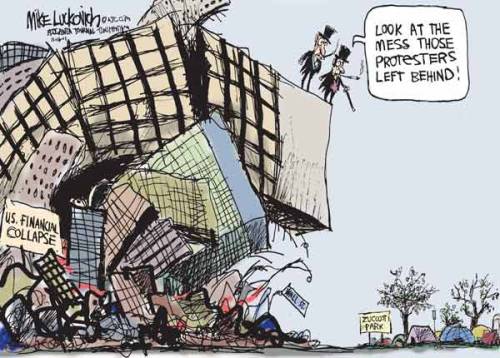
Let's get it right, Occupy Wallstreet
Coming from a strong conservative background and a tenacious passion for capitalism I am appalled by the amount of misinformation and lack of decent media coverage this protest merits. I'm writing this post because I'm tired of a few loud mouths that stereotype an entire movement as a bunch of lazy anti-capitalist hippies while failing to discuss any of the fundamental issues behind the movement.
Let's get some things straight.
OWS is not about pushing some liberal agenda into American politics with tents and pickets, it is the result of people's frustration with a lack of accountability for large businesses, the financial sector, and government agencies. Some call this class warfare, if that is true OWS certainly didn't start the war.
Now before any of you naysayers completely tune out, let me remind you that I LOVE capitalism, and I'm a conservative Republican from the most conservative state in America. So why would I support this movement? How could I possibly justify such blatant socialism? Because as a conservative Republican I believe that there does exists class warfare, I truly believe that our government has adopted a double standard for certain sectors of business, and I really do see an unfair system. Not in the sense of some people making ridiculous wages or returns, I'm all for capitalism, but in the blind eye to illegal financial and government practices.
Let me show you.
Source: http://www.rollingstone.com/politics/blogs/taibblog/finally-a-judge-stands-up-to-wall-street-20111110
 Near the end of 2010 Citigroup was brought to the SEC (Securities and Exchange Commission) for unfair and illegal practices. In essence, Citigroup bet against a package of mortgages they had designed to fail and lied to investors, stating that an independent party designed the package. In so doing, Citigroup made a profit of $160 million dollars causing $700 million dollars in damages.
Pause. Take it in. Now take this into account, Citigroup is what you would call a repeat offender and was in violation of the SEC's own cease-and-desist orders and injunctions.
Let it all settle. Now try to imagine the outcome.

Don't you want a legal system that treats the people up top the same way it treats the people on bottom? Doesn't that sound pretty American to you? because it does to me. Last time I checked Capitalism didn't exist to benefit businesses, it exists to benefit consumers. It is a system that intentionally pits companies against each other, with some rules of fair play, forcing them to viciously compete thereby benefiting consumers and those with enough chutzpah to enter the fray. OWS never addressed the issue of Capitalism, it has nothing to do with how Capitalism works, it is a simple yet powerful plea for justice, transparency, and accountability.
Let's get some things straight.
OWS is not about pushing some liberal agenda into American politics with tents and pickets, it is the result of people's frustration with a lack of accountability for large businesses, the financial sector, and government agencies. Some call this class warfare, if that is true OWS certainly didn't start the war.
Now before any of you naysayers completely tune out, let me remind you that I LOVE capitalism, and I'm a conservative Republican from the most conservative state in America. So why would I support this movement? How could I possibly justify such blatant socialism? Because as a conservative Republican I believe that there does exists class warfare, I truly believe that our government has adopted a double standard for certain sectors of business, and I really do see an unfair system. Not in the sense of some people making ridiculous wages or returns, I'm all for capitalism, but in the blind eye to illegal financial and government practices.
Let me show you.
Source: http://www.rollingstone.com/politics/blogs/taibblog/finally-a-judge-stands-up-to-wall-street-20111110
Pause. Take it in. Now take this into account, Citigroup is what you would call a repeat offender and was in violation of the SEC's own cease-and-desist orders and injunctions.
Let it all settle. Now try to imagine the outcome.
"[...] the SEC was trying to settle with Citi for just $285 million [...] without any admission of wrongdoing [...] as 'negligence' instead of intentional fraud"
"[...] the settlement is nuts. If you take Citi’s $160 million profit on the deal into consideration, what we’re talking about then is a $125 million fine for causing $700 million in damages. That, and no admission of wrongdoing.""So to recap: a unit of Citigroup, having repeatedly violated the same laws and having repeatedly violated the SEC’s own cease-and-desist orders and injunctions, is dragged into court one more time for committing a massive fraud."
"And what does the SEC do? It doesn’t even bring up Citi’s history of ignoring the SEC’s own order, slaps the bank with a fractional fine, refuses to target any individuals, allows the bank to walk away without an admission of wrongdoing, and puts a cherry on the top by describing the $160 million heist not as a crime, but as unintentional negligence."
Have I lost the naysayers already? Are there still some that would believe America is a land free of double standards? If so, the author draws a parallel to bring the message home.
Have I lost the naysayers already? Are there still some that would believe America is a land free of double standards? If so, the author draws a parallel to bring the message home.
If any citizen, you or I, were to commit a crime and get caught, even petty in nature, we would face possible criminal charges, jail time, and likely a permanent record of our wrong doing. What Citi did is like stealing someones car and getting caught flying down the freeway, not once, but multiple times, and then being let off by the officer with some marginal fine and no admission of guilt -- but orders of magnitude worse. Can you imagine that conversation?
Officer: "Sir, my records show that this car is stolen, did you steal this vehicle?"
Citi: "Oh Officer, I'm terribly sorry! I don't know how I ended up in this vehicle, one minute I was at home drinking coffee and the next I'm flying down the freeway in this Mercedes Benz!"
Officer: "Oh is that it? My records also show that you have previously been convicted of stealing a Ferrari, and a Lamborghini but I'm sure those are isolated incidents, right? I'll just have to give you a speeding ticket then and you can be on your way."
Can you even imagine?! If it were you or I we'd have reputations destroyed, lives ruined, and a lifetime prison sentence on top of some hefty fines.
Let's step back and look at the big picture.
Financial institutions and government agencies consciously ignored the warning signs on all those rotten sub-prime mortgages, even rating them as AAA safe, and when the whole thing comes burning down they come begging for a bailout. Where are the arrests? the criminal charges? the prison time?
Financial institutions and government agencies consciously ignored the warning signs on all those rotten sub-prime mortgages, even rating them as AAA safe, and when the whole thing comes burning down they come begging for a bailout. Where are the arrests? the criminal charges? the prison time?
For this very reason my blood boils when I hear rhetoric claiming OWS protesters are causing a mess and are lazy free loaders. Who was it that came to the American people asking for the largest bailout this country's ever seen? The very people that ruined the financial stability of the country -- it sure wasn't the OWS protestors.
Is America becoming a police state?
I was raised with the idea that the police could be trusted and that you could always find safety and proper resolution by involving law enforcement. Even though I still feel that most officers are good most of the time, I can't help but feel that the amount of power an officer carries, and a mindset of coercion, makes any association a risk.
Time and time again, with the advent of portable recording devices, officers are caught acting inappropriately, aggressively, and illegally. Is this a new issue? probably not, but it's clear that some law enforcement is clearly unaccustomed to the level of accountability its power merits. For the sake of this post, I tried to find the most blatant, and well-documented incidents supporting this position -- It is important to note that the citizen in the first video was able to debunk the officer's false account and suspend the officer because of his calm demeanor and recorded evidence of the incident, let it be a lesson.
For those unfamiliar with personal rights, no citizen is required to provide identification unless they have been placed under arrest. This is extremely important to remember since citizens are frequently bullied into giving this information and labeled "suspicious" or "uncooperative" if they exercise their right to privacy.
Though I was tempted to include videos from the UC Berkley pepper spraying incident, I feel that videos depicting officers illegally arresting, detaining, or harassing citizens who have done absolutely nothing even remotely illegal will show the extent to which some police will abuse powers and avoid accountability.
Not a police hater, I truly appreciate what they do, it's a hard job and I wouldn't want to do it, but we as a nation should not tolerate individuals who think a badge, a gun, and something to prove, qualifies you for the police force.
For those unfamiliar with personal rights, no citizen is required to provide identification unless they have been placed under arrest. This is extremely important to remember since citizens are frequently bullied into giving this information and labeled "suspicious" or "uncooperative" if they exercise their right to privacy.
Tuesday, February 28, 2012
The Cuckoo's Egg
This book brought to my attention the apparent need for greater collaboration between local, state, national, and international officials. I have found that in our modern era our laws were never intended to handle the unforeseen advances in telecommunications. Regrettably, I feel that our current government has taken a step in the wrong direction with laws such as the Patriot act which deny citizens virtually every right to privacy. I feel that our current system has made me slightly paranoid about our nations "cyber cops" similar to Stoll near the beginning of the book. My greatest fear is that government officials, ignorant of technology and it's finer details, will repeatedly commit inexcusable offenses to the masses in their attempt to "protect" our rights.
Tuesday, February 7, 2012
Current Event: Breaking the cycle of intellectual poverty
1: Recognizing the problem: http://www.ted.com/talks/lang/en/ken_robinson_says_schools_kill_creativity.html
2: The cycle: http://www.reuters.com/article/2012/02/07/us-obama-education-idUSTRE8161IQ20120207
3: Finnish success: http://www.smithsonianmag.com/people-places/Why-Are-Finlands-Schools-Successful.html
In recent news, Obama has decided to put an additional $80 million for some education program to aid math and science education. Having seen the video from TED talks (1) which discusses how "... schools kill creativity" and having read articles (3) answering the question "Why are Finlands schools successful" I have come to a belief that American education reform is not just, nor primarily, fiscal reform but it is a paradigm shift.
Here is the regrettable truth, our current U.S. education system is big, costly, and ineffective at mining the countries intellectual resources for the mathematical and scientific minds the private sector demands, let alone teaching children a more comprehensive way to be creative which would actually prepare them for a future in our dynamic market. I think most people recognize the problems easily, but perhaps the hardest truth for me to swallow is that our government and its burgeoning bureaucracy makes breaking this cycle an absolute nightmare. For now, presidents will continue to do what they've done for decades and just throw more money at the problem hoping that it will just go away long enough to be re-elected.
2: The cycle: http://www.reuters.com/article/2012/02/07/us-obama-education-idUSTRE8161IQ20120207
3: Finnish success: http://www.smithsonianmag.com/people-places/Why-Are-Finlands-Schools-Successful.html
In recent news, Obama has decided to put an additional $80 million for some education program to aid math and science education. Having seen the video from TED talks (1) which discusses how "... schools kill creativity" and having read articles (3) answering the question "Why are Finlands schools successful" I have come to a belief that American education reform is not just, nor primarily, fiscal reform but it is a paradigm shift.
Here is the regrettable truth, our current U.S. education system is big, costly, and ineffective at mining the countries intellectual resources for the mathematical and scientific minds the private sector demands, let alone teaching children a more comprehensive way to be creative which would actually prepare them for a future in our dynamic market. I think most people recognize the problems easily, but perhaps the hardest truth for me to swallow is that our government and its burgeoning bureaucracy makes breaking this cycle an absolute nightmare. For now, presidents will continue to do what they've done for decades and just throw more money at the problem hoping that it will just go away long enough to be re-elected.
Tuesday, January 31, 2012
Current Event: Mitt Romney's price of success
Original article:
http://online.wsj.com/article/SB10001424052970204740904577195041656788240.html
This article centers around Mitt Romneys push for the Florida GOP vote, but the issues brought to my attention are more vast. What does it take for a person to be elected as a representative in our government? or even more generally, to find success? Can an honest man succeed?
Using Mitt as an example, I'm going to come straight out and say that Mitt Romney is a politician in the sense that he will say and do what must be said and done to get elected. Though I'd like to believe that a consistent track record, both in and out of office, would earn you the public support needed to be elected, we see in the case of Ron Paul that this is rarely the case.
But does that mean that Mitt isn't honest? well... sorta. Where others see a, "perfectly lubed weather vein," I see a reliable, capable, and decent man simply trying to play the best hand of cards he can to earn a seat at the champions table. I for one have nothing against him for that. There was a time when I'd have thought that a good man couldn't use the weasly tricks of politicians to get elected without losing his integrity but that time has past and I would not call Romney's political strategies dishonest in the least, in my humble opinion he is simply playing the high-stakes game of American Politics. For this reason, I'm relieved to see a man of Mitt Romney's caliber who is also politically savvy enough to understand that sometimes you have to jump a few hoops to be able to make a difference.
http://online.wsj.com/article/SB10001424052970204740904577195041656788240.html
This article centers around Mitt Romneys push for the Florida GOP vote, but the issues brought to my attention are more vast. What does it take for a person to be elected as a representative in our government? or even more generally, to find success? Can an honest man succeed?
Using Mitt as an example, I'm going to come straight out and say that Mitt Romney is a politician in the sense that he will say and do what must be said and done to get elected. Though I'd like to believe that a consistent track record, both in and out of office, would earn you the public support needed to be elected, we see in the case of Ron Paul that this is rarely the case.
But does that mean that Mitt isn't honest? well... sorta. Where others see a, "perfectly lubed weather vein," I see a reliable, capable, and decent man simply trying to play the best hand of cards he can to earn a seat at the champions table. I for one have nothing against him for that. There was a time when I'd have thought that a good man couldn't use the weasly tricks of politicians to get elected without losing his integrity but that time has past and I would not call Romney's political strategies dishonest in the least, in my humble opinion he is simply playing the high-stakes game of American Politics. For this reason, I'm relieved to see a man of Mitt Romney's caliber who is also politically savvy enough to understand that sometimes you have to jump a few hoops to be able to make a difference.
Tuesday, January 17, 2012
The Digital Age: You can take our rights but not our Internet!
How important is the Internet to us? Experience has taught me that being a part of the world is to partake of the Internet – perhaps more appropriately dubbed the Wild Wild Web. The Internet’s awesome power to satisfy appetites of the mind and ability to connect the world has opened that special place in our hearts reserved for things we will fight to protect. This is evidenced by the recent throngs of web users and companies retaliating against SOPA, the Stop Online Piracy Act, which would create an internet blacklist of any site involved in or linking to sites involved in copyright infringement – coining the phrase, "the Great Firewall of America" for its striking similarities to China's questionable internet policies. In a time when Americans are subject to no-knock warrants, unprecedented government intrusion of privacy, and most recently indefinite detention by the military without trial, the internet nomads have begun rallying under the "stop SOPA now!" banner. In the tradition of our forefathers, Americans continue to fight for freedom, but it appears that as our lives have become digital so have the freedoms we will fight to protect.
Subscribe to:
Posts (Atom)